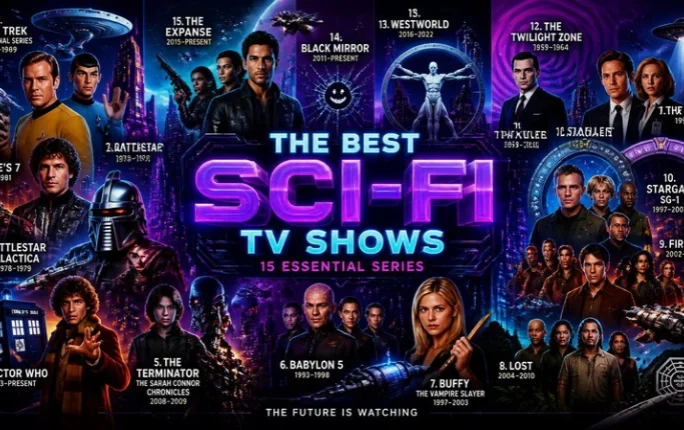
The best sci-fi TV shows can send you across space or trap you inside a mysterious office. Some explore artificial intelligence, while others imagine alien contact, time travel, or collapsing societies. The strongest series pair those ideas with characters you want to follow.
Our picks include modern hits such as Severance, Fallout, and Silo. Established favorites like The Expanse and Battlestar Galactica also earn prominent places. Classic series round out the list for viewers interested in the genre’s television history.
Quick answer: Start with The Expanse for ambitious space drama, Severance for cerebral mystery, or Fallout for post-apocalyptic adventure. Choose Black Mirror if you prefer standalone stories. Battlestar Galactica, Star Trek: The Next Generation, and The X-Files remain strong choices for viewers exploring influential science-fiction television.
Quick Comparison of Our Top Picks
| TV show | Best for | Style | Commitment |
| The Expanse | Space-opera fans | Political, detailed, serialized | Long |
| Battlestar Galactica | Military drama | Dark, tense, serialized | Long |
| Severance | Mystery fans | Cerebral, unsettling | Medium |
| Andor | Character-driven rebellion | Political, grounded | Medium |
| Dark | Time-travel puzzles | Complex, atmospheric | Medium |
| Black Mirror | Short standalone stories | Dystopian anthology | Flexible |
| Star Trek: The Next Generation | Optimistic exploration | Episodic adventure | Long |
| Fallout | Action and dark comedy | Post-apocalyptic | Medium |
| Silo | Dystopian mystery | Suspenseful, serialized | Medium |
| For All Mankind | Alternate history | Character-driven drama | Long |
| 3 Body Problem | Alien-contact stories | Large-scale mystery | Medium |
| Fringe | Procedural mysteries | Weird science | Long |
| Doctor Who | Time-travel adventure | Imaginative, episodic | Long |
| The X-Files | Paranormal investigations | Mystery, procedural | Long |
| Cyberpunk: Edgerunners | Adult animation | Fast, emotional, cyberpunk | Short |
Current genre listings show how broad science-fiction television has become. Popular U.S. options span Fallout, Severance, Andor, Silo, and For All Mankind. Older titles still appear prominently on major all-time lists.
How We Chose These Best Sci-Fi TV Shows
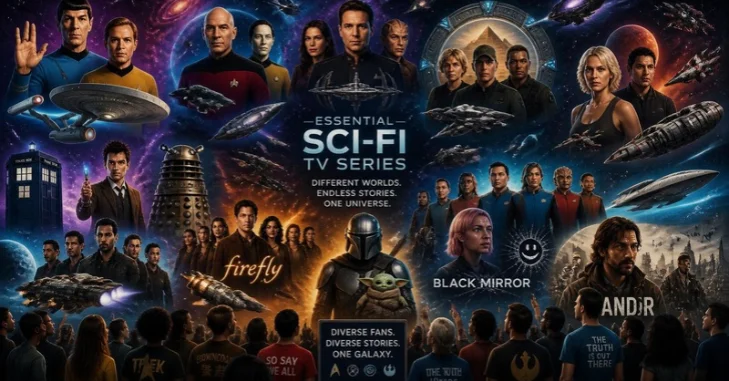
Best Sci-Fi TV Shows favored strong storytelling, memorable concepts, character development, and lasting appeal. Critical reception helped inform the selection, but scores didn’t decide every position. Different science-fiction subgenres also received space instead of filling the list with similar shows.
That approach creates choices for several viewing moods. You can find hard science fiction, dystopian mysteries, space adventures, cyberpunk animation, and accessible episodic television. Readers seeking more pop-culture coverage can also browse Webivest’s Entertainment section.
1. The Expanse
The Expanse combines space travel with political conflict between Earth, Mars, and communities living across the asteroid belt. Its future feels physically demanding rather than comfortably futuristic. That grounded approach gives its conflicts unusual weight.
The series becomes larger as its central mystery develops. Yet personal loyalties remain important when the political stakes expand. It suits viewers who want a detailed space opera with a substantial story.
Pros
- Detailed future setting
- Strong political conflicts
- Large serialized story
- Memorable ensemble cast
Cons
- Early episodes require close attention
- Political factions can initially seem complicated
Rotten Tomatoes places The Expanse among its prominent all-time science-fiction selections. Its editorial list reports a 95% Tomatometer score for the series.
2. Battlestar Galactica
The 2004 Battlestar Galactica follows humanity after a devastating attack by the Cylons. Survivors flee through space while searching for safety and questioning whom they can trust. The premise quickly becomes a story about survival, leadership, and identity.
Its military setting creates tension without making battles the only attraction. Political disagreements and moral compromises regularly affect the fleet. Rotten Tomatoes placed it first on its published all-time science-fiction television ranking.
Pros
- High-stakes serialized storytelling
- Strong moral conflicts
- Excellent ensemble drama
Cons
- Frequently bleak
- Later mythology can divide viewers
3. Severance
Severance imagines workers whose memories are divided between their professional and personal lives. Their office selves know nothing about life outside work. Their outside selves cannot remember what happens inside.
That simple concept supports a strange corporate mystery with sharp questions about identity. The controlled visual style makes ordinary hallways feel threatening. Current Rotten Tomatoes genre listings report a 95% Tomatometer score.
Pros
- Distinctive premise
- Strong mystery
- Precise visual identity
Cons
- Deliberate pacing
- Answers arrive slowly
4. Andor
Andor takes place inside the Star Wars universe but uses a grounded dramatic style. It examines how rebellion develops under an authoritarian system. Smaller personal decisions gradually connect to a much larger political conflict.
You don’t need constant lightsaber battles to enjoy its tension. Conversations, surveillance, prisons, and competing loyalties drive much of the story. Rotten Tomatoes currently lists Andor with a 96% Tomatometer score.
Pros
- Mature character writing
- Strong production design
- Accessible political thriller structure
Cons
- Slower than many Star Wars shows
- Less focused on traditional franchise spectacle
5. Dark
Dark begins with a missing child in a small German town. The mystery soon connects several families across different periods. Each discovery changes how earlier scenes look.
The series rewards careful viewing because relationships and timelines matter constantly. It works especially well for viewers who enjoy solving narrative puzzles. Watching in the original German audio can also preserve the performances’ natural delivery.
Pros
- Carefully constructed mystery
- Complex time-travel storytelling
- Strong atmosphere
Cons
- Requires concentration
- Large character network can be difficult to track
6. Black Mirror
Black Mirror uses standalone stories to examine technology and human behavior. One episode may focus on surveillance while another examines artificial reality. You can watch most installments without following a continuing plot.
That anthology structure makes the show unusually flexible. It also means tone and quality can differ between episodes. Rotten Tomatoes includes the program among its notable all-time genre selections.
Pros
- Standalone episodes
- Wide range of concepts
- Easy to sample
Cons
- Episodes vary in tone
- Many stories are intentionally bleak
7. Star Trek: The Next Generation
Star Trek: The Next Generation follows Captain Jean-Luc Picard and the Enterprise crew. Exploration often leads to ethical questions rather than straightforward battles. That structure gives many episodes satisfying individual stories.
The series is especially good for viewers who prefer hopeful speculative fiction. Some early episodes feel dated, but later seasons contain many franchise favorites. Rotten Tomatoes lists the show among the highest entries on its all-time genre ranking.
Pros
- Optimistic vision of the future
- Excellent standalone episodes
- Strong ethical storytelling
Cons
- Uneven early seasons
- Older effects reflect its production era
8. Fallout
Fallout adapts the video-game universe built around nuclear devastation and underground Vaults. Its America mixes retro imagery with mutants, violence, and bizarre technology. Dark comedy prevents the grim setting from becoming monotonous.
The show also works for viewers who haven’t played the games. Its characters introduce the setting without requiring extensive franchise knowledge. Rotten Tomatoes currently reports 94% from critics and 96% from audiences.
Pros
- Distinctive post-apocalyptic setting
- Strong dark humor
- Accessible to newcomers
Cons
- Graphic violence
- Tonal shifts won’t suit everyone
9. Silo
Silo follows a community living inside a huge underground structure. Residents are told the outside world is deadly. Questions about their history can carry dangerous consequences.
The central mystery unfolds through investigation rather than constant action. That makes the series suitable for fans of controlled, slow-building suspense. Rotten Tomatoes’ September 2026 genre page lists the show with a 92% critic score.
Pros
- Strong central mystery
- Effective enclosed setting
- Consistent suspense
Cons
- Slow-burn pacing
- Withholds information intentionally
10. For All Mankind
For All Mankind rewrites the space race by changing one major historical outcome. The resulting competition pushes space exploration along a different path. Personal stories develop alongside decades of technological change.
The alternate-history format gives familiar events new possibilities. It also lets the series explore how technological competition might reshape everyday life. Current Rotten Tomatoes listings give it a 91% Tomatometer score.
Pros
- Smart alternate-history premise
- Long-term character development
- Strong space-program focus
Cons
- Significant dramatic subplots
- Later seasons move far beyond the original era
11. 3 Body Problem
3 Body Problem begins with scientists confronting events that challenge their understanding of reality. The mystery gradually expands toward consequences for humanity itself. Its scale grows dramatically without abandoning the original scientific questions.
The series suits viewers who enjoy first-contact stories and large speculative ideas. Netflix describes it as an epic spanning space and time. Rotten Tomatoes currently lists a 78% critic score and 76% audience score.
Pros
- Ambitious central ideas
- Large-scale mystery
- Accessible introduction to its story
Cons
- Dense concepts
- Multiple storylines demand attention
12. Fringe
Fringe starts as a procedural about strange scientific cases. FBI agent Olivia Dunham works with scientist Walter Bishop and his son Peter. Their investigations gradually reveal a much larger serialized story.
The balance between weekly mysteries and long-term mythology makes it approachable. Walter also becomes one of the show’s strongest emotional anchors. Rotten Tomatoes lists Fringe among its notable all-time genre selections.
Pros
- Strong central characters
- Mixes procedural and serialized storytelling
- Creative science-fiction cases
Cons
- First season can feel formulaic
- Long episode count requires commitment
13. Doctor Who
Doctor Who follows a time-traveling alien known as the Doctor. Companions join the Doctor across different planets, historical periods, and futures. Regeneration allows new actors to reinterpret the central character.
Its enormous history can make choosing a starting point confusing. New viewers don’t need to begin with the earliest episodes, though. Rotten Tomatoes places the program near the top of its published all-time genre list.
Pros
- Huge variety of stories
- Imaginative time-travel premise
- Many possible entry points
Cons
- Quality varies between eras
- Extensive history can seem intimidating
14. The X-Files
The X-Files pairs FBI agents Fox Mulder and Dana Scully on unusual investigations. Mulder searches for extraordinary explanations while Scully brings scientific skepticism. Their contrasting perspectives drive both standalone cases and a continuing conspiracy.
The show influenced decades of paranormal and serialized television. Some effects naturally reveal its age, yet many individual episodes remain effective. Rotten Tomatoes includes it among its top historical science-fiction series.
Pros
- Iconic lead partnership
- Memorable standalone episodes
- Influential paranormal storytelling
Cons
- Long mythology becomes complicated
- Eleven seasons represent a major commitment
15. Cyberpunk: Edgerunners
Cyberpunk: Edgerunners tells a compact story inside the dangerous Night City setting. Its characters face corporate power, cybernetic modification, and brutal economic pressures. The animation gives those ideas explosive visual energy.
Its short length makes it easier to finish than most entries here. The emotional story also works without prior knowledge of the related game. Rotten Tomatoes currently reports a 100% critic score and 95% audience score.
Pros
- Short commitment
- Striking animation
- Emotional character arc
Cons
- Graphic violence
- Fast pacing gives viewers little downtime
Which Science-Fiction Series Should You Watch First?
Choose The Expanse if you want an expansive space story with political detail. Pick Severance or Silo when mystery matters more than spaceships. Both turn confined workplaces or communities into compelling speculative puzzles.
Fallout works better for action mixed with dark comedy. Star Trek: The Next Generation offers a more hopeful alternative. You can find more technology-related reading through Webivest’s Tech section.
For something short, try Cyberpunk: Edgerunners or selected Black Mirror episodes. Long-form viewers have deeper commitments available through Doctor Who, Fringe, and The X-Files. Gaming fans can also explore Webivest’s Gaming coverage after watching Fallout or Edgerunners.
Modern Sci-Fi Versus the Classics
Modern series usually benefit from larger visual-effects budgets and shorter seasons. Shows such as Silo and Severance also favor tightly serialized mysteries. Those qualities make them easy choices for viewers accustomed to streaming-era television.
Older programs often provide more standalone adventures and much larger episode libraries. The X-Files and Star Trek: The Next Generation let viewers sample individual stories before committing. Their influence also helps explain many storytelling conventions used by newer series.
Neither era owns a single definition of great science fiction. The right starting point depends on your preferred pace, tone, and commitment. That variety is one reason the genre remains so rewarding on television.
Find the Right Show for Your Next Binge
Science fiction television works best when the big idea supports an engaging human story. Space travel alone doesn’t make a series memorable. Characters, consequences, and compelling questions give these imagined futures staying power.
Start with the category that sounds most appealing instead of chasing one universal winner. Choose The Expanse for space, Severance for mystery, or Fallout for action. Then use the comparison table to find the next series that matches your mood.
FAQ About the Best Sci-Fi TV Shows
What are the best sci-fi TV shows to start with?
The Expanse, Severance, and Fallout offer three accessible but different starting points. They cover space opera, cerebral mystery, and post-apocalyptic adventure. Your preferred style should determine which one you try first.
What is a good sci-fi series for someone new to the genre?
Fallout is accessible because its characters introduce the strange setting alongside the viewer. Severance starts with a simple workplace concept before expanding its mystery. Black Mirror requires even less commitment because most episodes stand alone.
What sci-fi show should I watch after The Expanse?
Try Battlestar Galactica if political conflict and survival were your favorite elements. For All Mankind is another strong option for viewers interested in space exploration. 3 Body Problem shifts toward cosmic threats and scientific mystery.
Which science-fiction series is good for a short binge?
Cyberpunk: Edgerunners is the easiest short commitment on this list. Black Mirror also works because you can select individual episodes. Both provide substantial science-fiction ideas without requiring several long seasons.
Are classic science-fiction shows still worth watching?
Yes, especially when you want to understand the genre’s television history. Star Trek: The Next Generation remains strong for ethical and exploratory stories. The X-Files still works for viewers who enjoy paranormal investigations and character chemistry.