
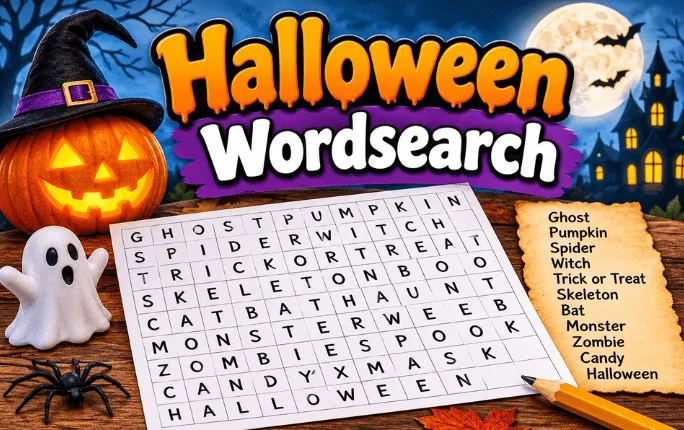
A Halloween wordsearch gives kids a simple seasonal activity without complicated rules or supplies. Use this puzzle at home, in class, or at a Halloween party. It includes 12 familiar words plus an answer key for quick checking. Quick answer: This free Halloween puzzle contains 12 kid-friendly seasonal words hidden in a 15-by-15 letter grid. Children can find words such as pumpkin, ghost, candy, spider, and costume. The easy format works well for elementary-age children, classroom stations, party tables, and quiet October activities.
| Puzzle detail | Information |
|---|---|
| Difficulty | Easy |
| Grid size | 15 × 15 |
| Words to find | 12 |
| Word direction | Left to right |
| Best for | Kids, families, classrooms, parties |
| Supplies | Printed page and pencil or marker |
| Answer key | Included below |
| Paper size | Works well on U.S. Letter paper |
Free Halloween Wordsearch for Kids
This puzzle uses recognizable seasonal vocabulary and a beginner-friendly layout—every hidden word runs from left to right, which reduces frustration for younger readers. Older children can race against a timer or compete to finish first. Look for the 12 words listed below the grid. Circle each word when you find it, then cross it off the list. Check the answer key only after you finish searching.
| Q | P | U | M | P | K | I | N | Z | X | C | V | B | N | M |
|---|---|---|---|---|---|---|---|---|---|---|---|---|---|---|
| A | S | D | F | G | H | O | S | T | Q | W | E | R | T | Y |
| Z | X | C | W | I | T | C | H | A | S | D | F | G | H | J |
| Q | W | E | R | T | C | A | N | D | Y | U | I | O | P | A |
| L | K | J | S | P | I | D | E | R | Z | X | C | V | B | N |
| S | K | E | L | E | T | O | N | Q | W | E | R | T | Y | U |
| M | N | V | A | M | P | I | R | E | A | S | D | F | G | H |
| C | O | S | T | U | M | E | Q | W | E | R | T | Y | U | I |
| Z | X | H | A | U | N | T | E | D | C | V | B | N | M | Q |
| P | L | K | J | B | R | O | O | M | M | N | B | V | C | X |
| C | A | U | L | D | R | O | N | Q | W | E | R | T | Y | U |
| A | S | D | F | G | H | J | K | L | B | A | T | Q | W | E |
| Q | A | Z | W | S | X | E | D | C | R | F | V | T | G | B |
| Y | H | N | U | J | M | I | K | O | L | P | Q | R | S | T |
| M | N | B | V | C | X | Z | L | K | J | H | G | F | D | S |
Words to Find
* PUMPKIN * GHOST * WITCH * CANDY * SPIDER * SKELETON * VAMPIRE * COSTUME * HAUNTED * BROOM * CAULDRON * BAT
Halloween Word Search Answer Key
The easy puzzle keeps every answer horizontal and facing forward. That format helps children practice scanning letters without adding several direction rules. Teachers can also use the key to check quickly during a classroom activity.
| Word | Location |
|---|---|
| PUMPKIN | Row 1 |
| GHOST | Row 2 |
| WITCH | Row 3 |
| CANDY | Row 4 |
| SPIDER | Row 5 |
| SKELETON | Row 6 |
| VAMPIRE | Row 7 |
| COSTUME | Row 8 |
| HAUNTED | Row 9 |
| BROOM | Row 10 |
| CAULDRON | Row 11 |
| BAT | Row 12 |
Keep the answer key separate when children first receive the puzzle. You can fold the page below the puzzle or display the key later. For groups, one adult can keep the answers while players search independently.
How to Use This Halloween Puzzle
A printed word search needs little preparation, so it fits several settings. Give each child a pencil, colored pencil, or highlighter before starting. Ask players to circle words rather than crossing through letters. For classroom use, the activity can work as morning work or an early-finisher task. It can also provide a quiet transition between longer lessons. Webivest has more material in its education section for readers interested in learning-focused topics. At home, place copies on a kitchen table before trick-or-treating begins. Children can work alone, cooperate with siblings, or race against a timer. A small prize can add friendly competition without changing the puzzle.
Make the Puzzle Easier for Younger Kids
Young readers often benefit from fewer words and predictable directions. Start with six words instead of all twelve if the full list feels crowded. You can also point out the first letter of one hidden answer. Let children use different colors for each word they find. Color coding makes completed answers easier to see and adds a creative element. Reading each word aloud can also reinforce familiar seasonal vocabulary. Parents can pair the puzzle with other short learning activities. Webivest’s article about homework and academic learning discusses the role of repeated practice in education. A short seasonal puzzle can provide a lighter form of focused practice.
Make It Harder for Older Children
Older kids may finish this version quickly because every answer runs horizontally. Cover the word list and ask players to identify Halloween terms without clues. You can also set a short time limit and record each player’s result. Another option is creating a second grid with diagonal or backward words. Longer vocabulary such as “jack-o’-lantern,” “graveyard,” and “trick or treat” adds difficulty. A larger 18-by-18 grid also creates more places for words to hide. You can turn the activity into a vocabulary challenge after the puzzle ends. Ask children to choose three found words and write a short story. Students who need broader study ideas can also explore Webivest’s learning tools and study resources.
Halloween Word Ideas for Your Own Puzzle
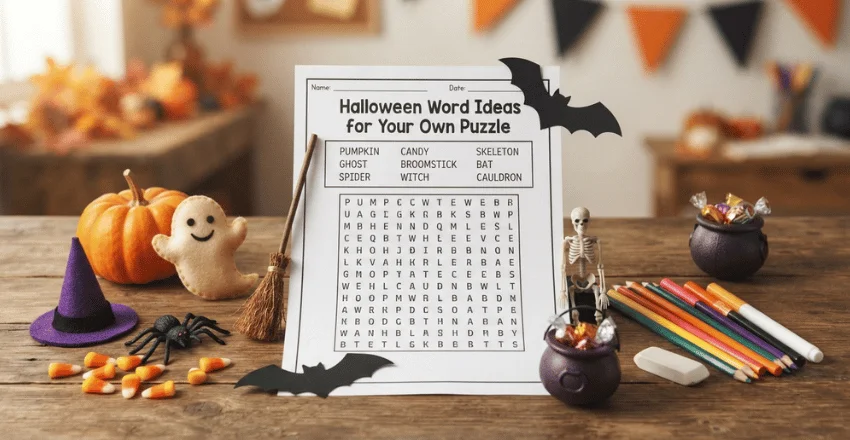
The best vocabulary depends on your players’ age and reading ability. Short, familiar words work well for beginning readers. Longer words create a stronger challenge for older elementary students.
Easy Words
Bat, Cat, Boo, Moon, Mask, Web, Owl, Candy, Ghost, and Witch.
Medium Words
Pumpkin, Spider, Costume, Zombie, Vampire, Haunted, Skeleton, Monster, Treat, and Broom.
Harder Words
Cauldron, Graveyard, Broomstick, Scarecrow, Tombstone, Werewolf, Cobweb, Moonlight, Frightening, and Jack-o’-lantern. Choose words that children can recognize before making the grid harder. Difficulty should come from searching, not confusing vocabulary. Explain unfamiliar terms before the activity begins.
Classroom Ideas Beyond Finding Words
A word search can become part of a longer language activity with little extra preparation. After students finish, ask them to sort the answers into people, objects, foods, and creatures. They can then explain why each word belongs in its group. Another activity is a spelling race using the completed word list. Read one word aloud and ask students to write it without looking. Afterwards, let them check their spelling against the puzzle. Students can also choose five words and create original sentences. This changes the activity from visual scanning into active vocabulary practice. Teachers seeking broader planning ideas can review Webivest’s tips for completing assignments on time.
Halloween Party Ideas Using the Word Search
Print one puzzle for each place setting at a Halloween party. Guests can work while waiting for food, games, or other activities to begin. Keep pencils nearby so nobody needs extra supplies. For a group challenge, divide players into small teams. Give each team the same puzzle and start everyone at the same time. The first group to find all twelve correct words wins. You can also turn each answer into a scavenger-hunt clue. A player might find “candy” before searching for a hidden treat bag. Another answer could point toward a pumpkin, costume, or decorative spider.
Printing Tips for U.S. Letter Paper
Most U.S. home and school printers use 8.5-by-11-inch Letter paper. Print the puzzle in portrait orientation and keep the grid large enough for comfortable reading. A black-and-white copy also saves color ink. Check the print preview before making classroom sets. Make sure no rows disappear beyond the page margins. Printing one test copy can prevent wasting a stack of paper. If letters appear small, increase the page scale slightly while keeping every row visible. Children should be able to distinguish similar letters without strain. Clear spacing matters more than decorative graphics.
Why Word Searches Work Well as Seasonal Activities
Word searches are easy to understand because the main task stays consistent. Players scan a letter grid, recognize a target sequence, and mark the result. Children can begin without learning several new rules. The seasonal theme also makes familiar reading practice feel different from ordinary worksheets. Words such as pumpkin, ghost, and costume connect the puzzle to October activities. That familiar context can keep children interested for longer. The activity remains flexible for different ages and settings. Adults can simplify the word list for younger players or increase the difficulty for older ones. The same basic puzzle can therefore work at home, school, or a community event.
Frequently Asked Questions
Is this Halloween wordsearch free to use?
Yes, the puzzle shown on this page can be used as a simple activity at home or in a classroom. You can print the page and give children their own copies. Keep the answer key separate if you want players to solve it independently.
What age is this Halloween puzzle best for?
The easy version works best for children who already recognize common Halloween vocabulary. Younger elementary students may appreciate the forward-only word placement. Older children can use a timer or try the harder variations described above.
Does the puzzle include an answer key?
Yes, the answer table lists the row containing each hidden word. In this beginner version, everyis beginner version, every answer appears from left to right. That makes it fast for parents and teachers to check completed sheets.
How many words are hidden in the puzzle?
The 15-by-15 grid contains-15 grid contains 12 hidden words. The list includes pumpkin, ghost, witch, candy, spider, and several other seasonal terms. Each word appears once.
How can I make a Halloween word search harder?
Add diagonal, vertical, and backward answers for a stronger challenge. You can also use longer vocabulary or increase the grid size. Removing the visible word list makes the activity harder again.
Is “wordsearch” one word or two?
Both spellings appear online, although “word search” is commonly written as two words. Searchers also use the combined spelling when looking for printable puzzles. The activity itself is the same either way.
A Simple Halloween Activity You Can Use Anywhere
A seasonal word search can fill ten quiet minutes or fit into a larger classroom lesson. It needs little setup and works with supplies most homes and schools already have. The included puzzle also gives adults a ready-made activity without having to create a grid from scratch. Print a copy, give each player a pencil, and start searching for the twelve hidden words. Adjust the challenge as needed for an easier or harder version. Then reuse the vocabulary for spelling, writing, or party games after the puzzle is complete.