
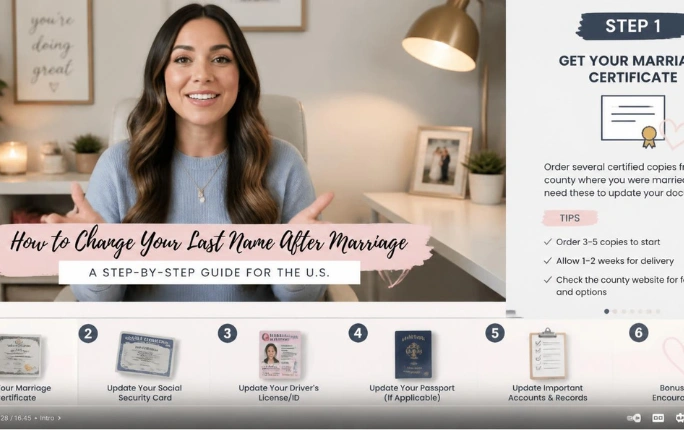
Getting married doesn’t automatically change your name across every government record, bank account, or identification document. If you decide to take your spouse’s surname or make another marriage-related name change, you generally need to update each organization separately and in a sensible order. Understanding How to Change Your Last Name After Marriage can help prevent mismatched records, rejected applications, tax problems, and unnecessary return trips. Knowing which document to change first can make the process more organized and easier to manage.
The exact requirements can vary by state and by the type of name you want to adopt. A standard change to a spouse’s surname is usually simpler than creating a completely new surname that is not supported by the marriage record. This guide explains how to change your last name after marriage in the United States and what to update once you establish your new legal name.
Quick answer: To change your last name after marriage in the U.S., get certified copies of your marriage certificate, update your name with Social Security first, then update your driver’s license or state ID. After that, update your passport, employer, financial accounts, insurance, voter registration, and other personal records. State requirements vary.
Do You Have to Change Your Last Name After Marriage?
No federal rule requires a person to take a spouse’s last name after getting married. You can generally continue using your existing legal name, and choosing not to change it does not make your marriage any less valid. Many couples also use different surnames throughout their marriage without creating a legal problem.
If you do want a new name, common choices include taking your spouse’s surname, combining or hyphenating surnames, or keeping a previous surname in another part of your name. However, the options available through the marriage process can depend on state law and the information recorded on your marriage documents. If you want an entirely unrelated surname or another change that your state does not recognize as marriage-based, you may need a separate court-ordered name change.
Name Change After Marriage: The Best Order
Following the right sequence makes the process easier because later organizations often rely on updated identification. Social Security is normally the best government record to change first, followed by your state-issued driver’s license or identification card. Once those core records match your new name, updating financial, employment, travel, and household accounts becomes more straightforward.
| Order | Record or Organization | Why It Matters |
| 1 | Marriage certificate | Provides evidence of the marriage and, when applicable, the name-change event |
| 2 | Social Security Administration | Establishes the updated name on your Social Security record |
| 3 | Driver’s license or state ID | Gives you current government-issued photo identification |
| 4 | U.S. passport | Keeps your travel identification consistent |
| 5 | Employer and payroll | Helps wages and tax reporting match SSA records |
| 6 | Banks and credit accounts | Aligns financial accounts with your updated identity |
| 7 | Insurance and benefits | Prevents inconsistencies in coverage and claims |
| 8 | Voter and government records | Keeps state and local records current |
| 9 | Personal and household accounts | Finishes the remaining administrative updates |
1. Decide Exactly What Your New Legal Name Will Be
Before submitting any applications, decide how you want your full legal name to appear. Using different versions of your new surname on different forms can create mismatches that later require corrections. Pay particular attention to spaces, hyphens, multiple surnames, suffixes, and any intended middle-name change.
Marriage-based naming rules differ by state. A marriage certificate will often support taking a spouse’s surname or using a surname derived from the spouses’ existing names, but more unusual changes may require a court process. If youare unsure whether your preferred name is permitted through marriage alone, check the name-change rules of the state where your marriage or identification documents are processed.
2. Get a Certified Copy of Your Marriage Certificate
Your marriage certificate is one of the most important documents in the process because it proves the legal event supporting your name change. This differs from simply applying for a marriage license before the wedding, and agencies may require a marriage document showing the marriage was completed and recorded. If you did not automatically receive certified copies, you can usually order them from the state, county, city, or vital-records office responsible for your marriage record.
Consider obtaining more than one certified copy if your issuing office allows it, especially if you plan to update several records within a short period. Some agencies may temporarily require an original or certified document, which can make having additional copies convenient. Keep at least one copy in a secure place instead of carrying all of them while completing routine updates.
Do not confuse a certified copy with a photocopy you later take to a notary. For example, Social Security states that when original evidence is required, it accepts original documents or copies certified by the issuing agency rather than ordinary photocopies or notarized copies. For broader background on how notarization works, Webivest also explains why notary services matter and what a notary actually verifies.
3. Change Your Name With Social Security
Updating your Social Security record should normally come before changing your driver’s license or tackling financial records. The Social Security Administration says a person who legally changes their name because of marriage should request a corrected replacement card by filing Form SS-5, the Application for a Social Security Card. Your Social Security number stays the same; the agency updates the name connected to the record and issues a replacement card showing that name.
Depending on your circumstances, SSA may let you complete the process online or start it online and finish it at a local Social Security office or Card Center. If an in-person step is necessary, SSA may require evidence of your legal name change and identity, and in some cases may also require citizenship or immigration evidence. SSA accepts a marriage document as evidence for a legal name change.
There is no fee for a corrected Social Security card. SSA’s current name-change information says it generally mails an updated card after the request is completed, and it currently states a typical delivery window of five to ten business days. You should also notify your employer after the Social Security update so payroll and wage reporting can match your new record.
4. Update Your Driver’s License or State ID
After updating Social Security, contact your state’s motor vehicle agency to update your driver’s license, learner permit, or non-driver identification card. Each state sets its own documentation, fee, timing, appointment, and residency requirements, so don’t rely on another state’s checklist. USAGov specifically recommends contacting your state motor vehicle office after a legal name change.
You will usually need your existing license or ID, proof of your legal name change, and any additional identity or residency documents the state requires. Some states verify Social Security information before completing the transaction, which is another reason to update SSA first. New York, for example, states that a name-change application for a state photo document can be rejected if the applicant has not already changed the name with Social Security.
Don’t assume you can complete the process entirely online just because your state offers online license renewals. A legal name change may require an office visit or additional document review even when ordinary renewals are available digitally. Check your own state DMV, BMV, MVD, RMV, or equivalent agency before making the trip.
5. Change the Name on Your U.S. Passport
If you have a U.S. passport, changing your surname on Social Security does not automatically update it. The State Department uses different procedures depending on when it issued your passport and when your legal name changed. You may need your marriage certificate or another certified legal name-change document as evidence.
The State Department currently separates common passport name-change situations as follows.
| Situation | Typical Process |
| Both the passport issuance and legal name change were within the last year | Form DS-5504, current passport, name-change evidence, and passport photo |
| More than one year has passed since either event | Renewal using Form DS-82 if eligible |
| You are not eligible to renew by mail | Apply in person using Form DS-11 |
| No legal document shows the name change | Additional evidence and a different procedure may apply |
When Form DS-5504 applies to a qualifying recent name change, the State Department’s instructions for changing or correcting a passport say there is generally no regular application fee, although optional expedited service costs extra. Applicants using a standard renewal or a new in-person passport application may have to pay the applicable passport fees. Always check the current State Department instructions immediately before applying because forms, fees, and processing rules can change.
How to Change Your Last Name After Marriage When You Have Upcoming Travel
When considering how to Change Your Last Name After Marriage, airline reservations and travel documents should match closely enough to satisfy the carrier and border or security requirements for your trip. Changing your passport shortly before international travel can create unnecessary complications if you purchased tickets under your previous name. Before changing travel documents, review your airline’s name-correction policy and current passport processing options.
Do not assume that carrying a marriage certificate will always solve a ticket-and-passport mismatch. Airline policies and international entry requirements can differ, and carriers may impose their own documentation rules. When travel is imminent, verify the requirements before submitting a passport that you may need for the trip.
6. Tell Your Employer and Update Payroll Records
Once your Social Security record has changed, tell your employer or payroll department your new legal name. Your employer needs accurate identifying information to report your wages and prepare tax documents such as Form W-2. Keeping payroll and SSA records consistent also reduces the chance of problems when earnings are credited to your Social Security record.
This is also a good time to update workplace email directories, identification badges, retirement accounts, health benefits, life insurance, and beneficiary information. Marriage itself may qualify as a life event for certain employer-sponsored benefit changes, separate from the name change. Ask your benefits administrator whether any enrollment deadlines apply to changes you want to make after marriage.
7. Make Sure Your Tax Records Match
You generally don’t file a separate federal form with the IRS to change the name on your Social Security record; the IRS relies on the name on your Social Security record, which makes updating SSA before filing a federal tax return especially important. USAGov notes that names used on federal tax returns should match Social Security records.
A mismatch can contribute to processing delays, especially if your tax return or wage forms use your new surname while SSA still has the old one. The IRS also reminds taxpayers who change their names because of marriage or divorce to report the change to Social Security before filing certain federal forms. Keep this in mind if you get married close to tax season and plan to begin using your new name immediately.
8. Update Banks, Credit Cards, Loans, and Investments
After you have current government identification, begin updating your financial institutions. Banks and credit-card issuers have their own identity-verification procedures, and some may request your new photo ID along with your marriage certificate. Update the name on checking and savings accounts, credit cards, brokerage accounts, retirement accounts, mortgages, auto loans, and other financial products you use.
Changing your surname does not erase or restart your financial history. Your Social Security number and existing accounts still connect your identity across financial systems, even if your legal name changes. Still, keeping records consistent can make future applications, account servicing, identity verification, and document signing much easier.
If you use checks, payment apps, digital wallets, or business payment platforms, update them after you correct the underlying bank or card accounts. Couples should also review beneficiaries and payable-on-death designations rather than assuming marriage automatically changes every financial instruction. A name-change project is a useful opportunity to make sure those records still reflect your wishes.
9. Update Insurance, Voter Registration, and Other Records
Once you’ve updated your main identification and financial records, work through the remaining accounts that use your legal name. USAGov recommends updating relevant federal, state, and local government records, including voter registration where applicable. Vote.gov specifically tells voters to update their registration after changing their legal name, while the exact procedure and deadline depend on the state or territory.
Use this checklist to catch commonly overlooked records:
| Category | Records to Review |
| Insurance | Health, dental, vision, auto, homeowners, renters, life |
| Medical | Doctors, pharmacies, hospitals, health portals |
| Property | Mortgage, deed-related records, landlord or lease |
| Transportation | Vehicle registration, title, toll accounts |
| Financial | Banks, cards, loans, investments, retirement plans |
| Government | Voter registration, benefits, state tax records |
| Household | Utilities, mobile phone, internet, subscriptions |
| Professional | Licenses, certifications, professional associations |
| Education | University, alums, student-loan records |
| Digital | Payment apps, loyalty programs, trusted-traveler accounts |
You do not have to update every minor account on the same day. Start with records that affect identity verification, travel, employment, money, insurance, and legal rights, and then work outward to less important memberships or subscriptions. Keeping a simple spreadsheet or checklist of each request’s date and status can prevent duplicate work.
What If You Have a Green Card or Other Immigration Documents?
Noncitizens may have additional immigration records to consider after legally changing their names. USCIS instructions for replacing a Permanent Resident Card state that a person whose biographic information has legally changed may use the appropriate replacement-card process and provide legal documentation reflecting the change. A registered marriage certificate is one example of supporting evidence USCIS identifies for a legal name change.
Do not assume that updating Social Security automatically updates USCIS, a green card, an employment authorization document, or every immigration record. Immigration consequences can depend heavily on an individual’s status and documents, so use current USCIS instructions for the specific form you need. For readers dealing with wider immigration matters, Webivest also has background information on family-based immigration, status adjustments, and related U.S. immigration issues.
Do You Need a Court Order to Change Your Name After Marriage?
For many straightforward marriage-related surname changes, a certified marriage document can provide the legal evidence needed to update government records. That commonly includes taking a spouse’s surname or another option recognized under applicable state rules. USAGov emphasizes that the legal process for changing a name after marriage can vary by state.
A court order may be necessary if your desired name isn’t permitted through your state’s marriage-based process or cannot be established from your marriage documentation. This can happen when someone wants an entirely new surname unrelated to either spouse’s existing name or when the marriage record does not support the requested change. Because these rules are state-specific, check your state or local court requirements rather than assuming one national rule applies.
How Much Does It Cost to Change Your Last Name After Marriage?

There is no single nationwide price because several agencies are involved. Updating a Social Security card is free, while a state driver’s license or identification card may involve a replacement or amendment fee. Passport costs depend on the form and procedure, and certified marriage certificates often include local record-copy fees.
| Item | Typical Cost Structure |
| Social Security name update | No charge |
| Certified marriage certificate | Fee depends on issuing office |
| Driver’s license/state ID | State-specific fee |
| Passport using qualifying DS-5504 process | Generally no regular fee; optional services may cost extra |
| Passport renewal or new application | Current passport fees apply |
| Bank and employer updates | Usually no direct name-change fee |
| Court-ordered change, if required | Court and publication requirements vary by state |
Avoid relying on third-party name-change services for government fee information without checking the agency itself. A service may charge for convenience even when the underlying government transaction is free. Government agencies publish their official forms and current fee schedules directly.
How Long Does a Name Change After Marriage Take?
There is no universal completion time because you are not submitting one national name-change application. Social Security, your state motor vehicle agency, the State Department, banks, insurers, employers, and other organizations each process updates separately. The entire project can therefore take several weeks, even if the most important records are updated relatively quickly.
SSA currently says it generally mails a replacement card within five to ten business days after it completes the request, while state ID and passport timelines follow separate processes. Passport timing, in particular, can change with demand and the service selected, so check the State Department’s current processing information when you apply.
You also don’t need to postpone every secondary account until you physically have every replacement document. Some organizations will accept the marriage certificate plus existing identification, while others insist on a newly issued ID in the changed name. Prioritize Social Security and your state ID, then follow each organization’s instructions.
Common Name-Change Mistakes to Avoid
A common mistake is updating records in a random order. Starting with banks or a driver’s license before the underlying identity records are ready can create verification problems, depending on the institution and state. Using the sequence of marriage certificate, Social Security, state ID, and then other organizations reduces unnecessary inconsistencies.
Another problem is assuming a plain photocopy of a marriage certificate will satisfy every agency. Requirements differ, and agencies such as SSA may require original evidence or a copy certified by the issuing authority rather than a photocopy or notarized substitute. Read each agency’s document requirements before mailing valuable originals or arriving for an appointment.
Finally, avoid using several versions of the new name at the same time. A missing hyphen, inconsistent middle name, or different surname order can become surprisingly troublesome when records are compared. Decide on the exact legal format first and use it consistently across Social Security, identification, taxes, financial accounts, and travel documents.
Final Thoughts
Learning how to change your last name after marriage becomes much easier when you treat it as a sequence rather than one enormous administrative task. Start with certified marriage documentation, update Social Security, get your new state ID, then work through your passport, employer, taxes, finances, insurance, voter registration, and remaining accounts. Keeping your name formatted consistently throughout the process can save considerable time later.
The most important detail is that state requirements vary. A naming option, document, waiting period, fee, or DMV procedure that works in one state may differ elsewhere, so use current official instructions for your jurisdiction. With the core records handled first and a checklist for everything else, you can complete the change methodically without overlooking the documents you rely on most.
Frequently Asked Questions
Can I keep my maiden name after marriage?
Yes, getting married does not generally require you to take your spouse’s surname. You can continue using your existing legal name and remain legally married. If you later decide to change it, follow the applicable state and agency procedures in effect at that time.
Is my name automatically changed when I get married?
No, marriage itself does not automatically update your Social Security record, driver’s license, passport, bank accounts, or other existing records. Your marriage certificate can provide the legal evidence needed for a qualifying change, but you must normally contact the relevant organizations individually. That is why an organized sequence helps.
What document proves my name change after marriage?
A certified marriage certificate is commonly used as evidence of a marriage-based legal name change. Different agencies may have additional identification or documentation requirements, and the exact information needed can depend on how the new name is derived. Always follow the instructions of the specific government agency or institution you are updating.
Should I change Social Security or my driver’s license first?
Updating Social Security first is generally the most practical order. USAGov recommends notifying SSA early, and some state motor vehicle agencies verify Social Security records when processing a name change. After SSA has processed the update, proceed with your state’s driver’s license or ID requirements.
Does changing my last name change my Social Security number?
No, a legal name change does not ordinarily give you a new Social Security number. SSA issues a corrected card showing the updated name while retaining the same number associated with your record. This continuity is one reason your employment, tax, and financial history remains connected after marriage.
Do I need to notify the IRS separately after changing my name?
For a typical marriage-related name change, your first federal identity update is with Social Security, not a special IRS name-change application. Your federal tax return should use a name that matches SSA’s records to help prevent processing problems. Update SSA before filing a return under your new name.
Can I change my passport before changing Social Security?
The State Department has its own passport name-change evidence requirements, so its procedure is technically separate from the Social Security card process. However, changing Social Security first and then obtaining updated state identification gives you a more orderly set of matching records. If international travel is approaching, consider your passport and ticket timing before submitting documents.
Can both spouses change their last names?
Marriage-based naming options are not limited to one gender, but the exact surnames available through marriage documentation depend on applicable state rules. Either spouse may be able to adopt or combine surnames when the law allows it. supports the c supchange. Unchanged names may require a court order, so verify local requirements before completing applications.