

No Face is the mysterious masked spirit from Hayao Miyazaki’s Spirited Away. He appears quiet and lonely at first, then becomes dangerous inside the bathhouse. His transformation reflects the people, desires, and behavior surrounding him rather than a fixed evil nature.
The character is often treated as a simple symbol of greed. That reading captures part of his story, but it misses his deeper connection to identity and belonging. His behavior suggests a being without a stable sense of self, searching for acceptance through imitation.
| Quick fact | Details |
|---|---|
| Character | No-Face |
| Japanese name | Kaonashi |
| Film | Spirited Away |
| Director | Hayao Miyazaki |
| Film release | July 20, 2001 in Japan |
| Appearance | Black, shadow-like body with a white mask |
| Central themes | Identity, loneliness, imitation, greed, consumption |
| Connection to Chihiro | He becomes attached after she treats him kindly |
| Final situation | He remains peacefully with Zeniba |
Direct answer: No Face represents more than greed in Spirited Away. He lacks a strong identity and absorbs behavior from people around him. The bathhouse makes him greedy and destructive, while Chihiro and Zeniba expose him to kindness, restraint, and calm. His changing personality makes the environment central to his meaning.
Key Takeaways
- The character is not presented as purely evil.
- He copies attitudes and desires from his surroundings.
- The bathhouse encourages greed, excess, and status seeking.
- Chihiro refuses his gold and treats him differently.
- Leaving the bathhouse changes his behavior quickly.
- His story connects identity, loneliness, consumption, and belonging.
- Zeniba gives him a healthier environment and useful purpose.
Who Is No Face in Spirited Away?
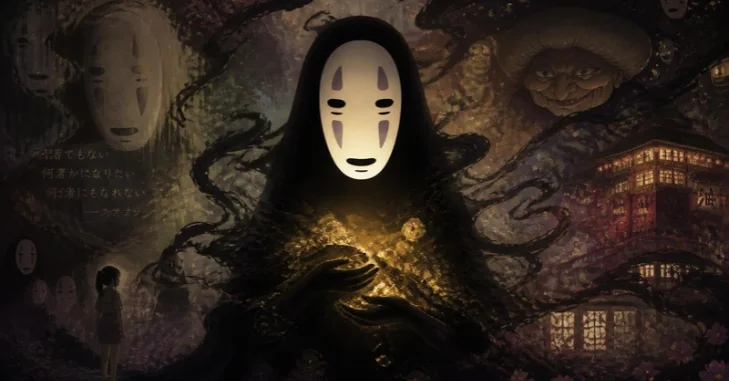
No Face first appears as an almost transparent spirit standing outside the bathhouse. Chihiro notices him and later allows him inside during the rain. That small act of kindness appears to make her especially important to him.
Inside, he watches workers respond enthusiastically to money and wealthy customers. He then learns that gold can attract attention, service, and praise. His quiet desire for connection becomes mixed with the bathhouse’s obsession with consumption.
Studio Ghibli lists Spirited Away as Miyazaki’s 2001 film, with a running time near 125 minutes. The story places Chihiro among spirits after her parents undergo a frightening transformation. No-Face becomes one of the film’s most memorable examples of how that spirit world tests identity.
What Does No-Face Represent?
The strongest interpretation combines identity, loneliness, imitation, and greed. His destructive appetite does not appear immediately when Chihiro meets him. It develops after he enters an environment where attention is exchanged for money and consumption.
That distinction matters because it changes how viewers understand his behavior. He does not simply arrive as a greedy monster who happens to meet Chihiro. Instead, he becomes increasingly monstrous while copying the desires encouraged around him.
This also explains why his personality seems difficult to define. His identity depends heavily on his surroundings and the creatures he consumes. He even gains characteristics associated with people he swallows inside the bathhouse
Why Does No-Face Become Greedy?
The bathhouse teaches him what its workers value. Gold immediately earns him food, attention, admiration, and special treatment. He responds by producing more gold and demanding increasing amounts of everything.
Food then becomes another form of endless consumption. The workers keep satisfying his appetite because they expect wealth in return. His body grows while his behavior becomes increasingly aggressive and difficult to control.
The sequence connects him to a wider theme already present throughout the film. Chihiro’s parents also lose control while consuming food that does not belong to them. Greed repeatedly causes characters to overlook consequences that should otherwise seem obvious.
Why Is He So Attached to Chihiro?
Chihiro gives him something that the bathhouse cannot provide. She recognizes him before he has money, status, or anything useful to offer. Her kindness is therefore separated from the transactional behavior he later encounters.
He tries to repeat his successful bathhouse strategy with her by offering gold. Chihiro refuses because she does not want what he is using to control everyone else. Her reaction breaks the pattern he learned from the workers.
That refusal also explains why their relationship becomes emotionally important. He cannot purchase Chihiro’s approval, so he has to confront a different kind of connection. She treats him as a troubled being rather than a wealthy customer.
Is No-Face Evil?
Calling him purely evil makes several later scenes difficult to explain. His worst behavior emerges inside one specific environment and decreases after he leaves it. A permanently malicious character would not change so dramatically after changing surroundings.
Chihiro also responds to him differently than she responds to clear threats. She confronts his dangerous behavior, but she does not treat his existence as inherently wicked. She eventually allows him to accompany her away from the bathhouse.
His final scenes strengthen that interpretation. Once he reaches Zeniba’s quieter home, his aggression disappears and he participates peacefully. The change suggests harmful surroundings were influencing behavior that never represented his entire nature.
Readers who enjoy morally complicated fictional characters may also like Webivest’s analysis of whether Dumbledore was truly bad. Both characters invite more interesting answers than simple hero-or-villain labels. Each becomes clearer when motives, choices, and surrounding influences are considered together.
Why Does Chihiro Refuse His Gold?
Chihiro does not share the bathhouse workers’ excitement about his wealth. She already understands that getting what she needs matters more than accumulating everything available. That restraint separates her from the people feeding his growing appetite.
Her refusal also prevents their relationship from becoming another exchange. She does not flatter him for payment or change her behavior because he appears wealthy. He therefore cannot use gold to create the acceptance he wants.
This moment supports one of the film’s clearest contrasts. Material abundance fails to produce the emotional connection that the spirit seeks. Simple compassion succeeds where endless consumption does not.
What Does His Mask Mean?
The film never pauses to provide one official explanation for every visual detail. Still, the mask naturally reinforces questions about identity because viewers see a fixed face covering an unstable being. His visible expression remains simple even while his body and behavior change.
That design creates an interesting contradiction. He has one of the film’s most recognizable faces while possessing one of its least stable identities. The white mask becomes a surface that reveals little about what exists underneath.
His Japanese name, Kaonashi, is commonly associated with the idea of being faceless. That makes the visual design particularly fitting for a character shaped by others. His missing personal identity matters more than his literal lack of human features.
Why Does No-Face Calm Down After Leaving the Bathhouse?
Physical distance removes him from the behavior he had been copying. The bathhouse rewards excess, while Chihiro’s journey toward Zeniba demands patience and restraint. His transformation begins reversing once those social incentives disappear.
The famous train sequence makes that change especially visible. He stops demanding constant service and quietly follows Chihiro instead. The film shifts from noise and excess toward silence, travel, and reflection.
Zeniba’s home completes that change by giving him a calm place to remain. He can participate in ordinary work without buying anyone’s attention. He finally finds companionship that does not depend on gold or consumption.
Greed Versus Identity: The More Complete Interpretation
Greed is clearly part of the character’s meaning, but it works better as a symptom. The deeper problem is his inability to maintain an identity independent of his environment. A greedy setting therefore produces greedy behavior.
This reading also connects him more closely with Chihiro’s own story. She faces pressure to lose her name and accept an identity chosen by Yubaba. Unlike the masked spirit, she gradually strengthens her sense of self instead of surrendering it.
Their paths therefore move in opposite directions before briefly joining. Chihiro becomes more secure as the story progresses, while he becomes unstable through imitation. Her influence eventually helps lead him toward an environment where he can exist without constant performance.
Fans interested in other stories built around identity and unusual situations can browse Webivest’s entertainment coverage. The section includes film, television, celebrity, and pop-culture explainers for further reading. It also provides a natural starting point for more character-focused features.
Why the Character Still Connects With Viewers
The character remains relatable because his problem extends beyond fantasy. People can absorb habits, priorities, and expectations from families, workplaces, social groups, and online communities. An uncertain identity can make that influence especially powerful.
His story also avoids a simple transformation from monster to hero. He becomes dangerous, causes harm, and needs to leave the setting, encouraging that behavior. Yet the film still leaves room for change when his circumstances improve.
That combination gives the character unusual emotional range. He can appear frightening, lonely, funny, destructive, and peaceful within the same story. Those contradictions make him more memorable than a straightforward villain.
For more screen recommendations, Webivest also has a guide to 15 science-fiction TV shows worth watching. It offers another route into stories about identity, unusual worlds, and human behavior. Readers can use it after finishing this character analysis.
Frequently Asked Questions
What is No Face supposed to represent?
No Face represents a combination of loneliness, weak identity, imitation, greed, and emotional dependence. His behavior changes according to the environment and people surrounding him. The bathhouse brings out destructive consumption, while calmer surroundings produce gentler behavior.
Why does No-Face eat people?
Eating others appears connected to his growing appetite and unstable identity inside the bathhouse. Consuming workers also lets him absorb characteristics associated with them. The behavior becomes part of his escalating attempt to satisfy needs that food and gold cannot resolve.
Why does No-Face want Chihiro?
Chihiro is among the first characters to show him uncomplicated kindness. She does not value him because of his gold or apparent status. That makes her attention different from the reactions he receives elsewhere.
Is No-Face based on Japanese folklore?
The character has inspired comparisons with Japanese supernatural traditions and faceless beings. Still, viewers should avoid treating every resemblance as a confirmed one-to-one adaptation. Miyazaki’s character functions primarily within the film’s own themes of identity and behavior.
Why does No-Face stay with Zeniba?
Zeniba provides a peaceful environment where he can help without buying affection. He becomes calm once removed from the bathhouse’s cycle of greed and excess. Staying there suggests he has finally found a setting that supports healthier behavior.
The Bottom Line
No-Face works best as a character shaped by what surrounds him. Greed explains his bathhouse rampage, but identity and loneliness explain why that greed takes control. His peaceful ending shows that environment can influence both destructive behavior and recovery.
That makes his story an effective companion to Chihiro’s development. She learns to protect her identity while he struggles because he lacks one. Their connection turns a strange masked spirit into one of Spirited Away’s clearest studies of belonging.
The next time you watch the film, follow how his behavior changes from scene to scene. Notice who surrounds him, what those characters value, and how they treat him. Those details reveal more about the character than the mask ever does.