
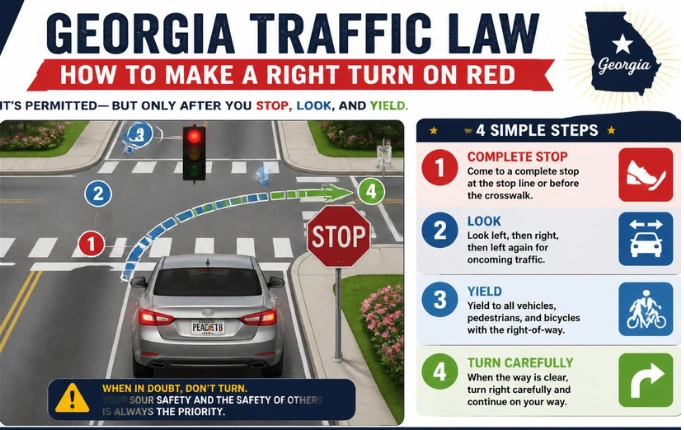
Does Georgia law require you to stop before turning right on a red light? Yes, and the stop has to be a complete one before you make the turn. You can then turn right on a steady circular red when the movement is permitted, the intersection is clear, and you have yielded to pedestrians and other lawful traffic.
Direct answer: Yes. Georgia requires a complete stop before a driver turns right on a steady circular red light. Stop at the marked stop line or before the crosswalk or intersection when no line exists. Then yield to pedestrians and lawful traffic, and turn only when no sign prohibits it and the movement is safe.
| Georgia’s right-on-red rule | What drivers should know |
| Complete stop required? | Yes. |
| Right turn on steady circular red allowed? | Usually, after stopping and yielding |
| Stop location | Stop line first; otherwise, before the crosswalk or intersection |
| Pedestrians | Stop and remain stopped when required for pedestrians. |
| Other traffic | Yield to traffic lawfully using the intersection. |
| “No Right Turn on Red” sign | The turn is prohibited. |
| Steady red arrow | Do not make the movement shown by the arrow. |
| Flashing red arrow | A right turn may be made after stopping and yielding. |
| License points | O.C.G.A. § 40-6-21 is listed as a 3-point offense upon conviction. |
Key Takeaways
- A rolling stop is not enough; the vehicle must come to a complete stop.
- A right turn on red is generally permitted after stopping, but it is not mandatory.
- A posted sign can prohibit the turn even when the intersection otherwise allows it.
- Pedestrians and lawful cross traffic retain the right of way.
- A steady red arrow is different from a steady circular red signal.
- Georgia DDS lists failure to obey a traffic signal under O.C.G.A. § 40-6-21 as a 3-point offense.
Does Georgia Law Require You to Stop Before Turning Right on a Red Light?
Does Georgia law require you to stop before turning right on a red light? Georgia’s rule is straightforward: you must stop completely before making a permitted right turn against a red signal. The Georgia Department of Driver Services says a driver may proceed only after making a complete stop, yielding to traffic and pedestrians, and deciding that the turn can be completed safely. A posted sign prohibiting the movement overrides the normal right-on-red permission.
The rule is also reflected in O.C.G.A. § 40-6-21, which governs the meaning of Georgia traffic signals. The statute permits traffic facing a steady circular red to make a right turn after first stopping as required by the law. Drivers who want more plain-language explanations of legal rules can also browse Webivest’s Law section.
Where Must You Stop at a Red Light in Georgia?
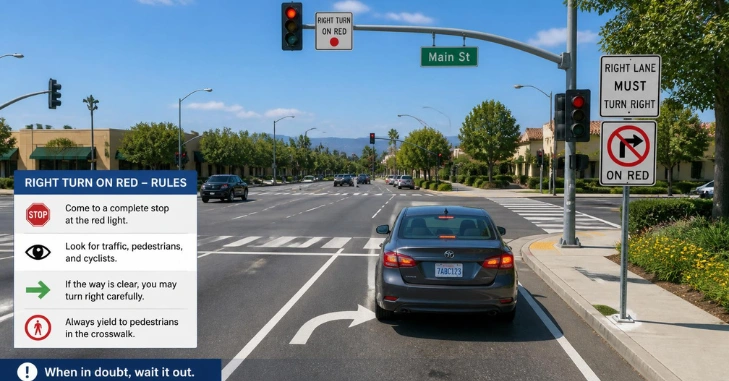
The required stopping point matters because stopping after entering the crosswalk can still interfere with pedestrians. Georgia law directs a driver to stop at a clearly marked stop line when one exists. If there is no stop line, the driver stops before entering the crosswalk or before entering the intersection when there is no crosswalk.
Georgia DDS gives drivers the same practical instruction and specifically warns against blocking the crosswalk while waiting to turn. The agency tells drivers turning right on red to make a full and complete stop before the crosswalk. It also recommends checking both the traffic approaching from the left and pedestrians who may be crossing from the passenger side.
Use this order when approaching the intersection:
- Stop at the marked stop line, if one is present.
- If there is no stop line, stop before the near-side crosswalk.
- If there is neither a stop line nor a crosswalk, stop before entering the intersection.
- Check for pedestrians, bicycles, and vehicles with the right of way.
- Make the right turn only when it is permitted and safe.
What Must You Yield to Before Making the Turn?
A green light for cross traffic means those vehicles may already be moving through the intersection. A driver waiting at the red signal must yield to traffic that is lawfully using the intersection before turning. The fact that a right turn on red is allowed does not give the turning vehicle priority.
Pedestrian duties are equally important because a driver may be watching approaching cars and miss someone entering the crosswalk from the right. Georgia DDS tells motorists to stop and remain stopped for pedestrians when required and to avoid blocking the crosswalk. A safe turn therefore requires checking both vehicle traffic and the entire pedestrian path before moving.
When Is a Right Turn on Red Not Allowed?
A posted prohibition is the clearest exception to the usual rule. Georgia DDS identifies “No Right Turn on Red After Stop” signage as meaning the driver may not turn even after making a complete stop. In that situation, you must remain stopped until the traffic signal permits the turn.
Drivers should also distinguish a circular red signal from a red arrow because Georgia law treats them differently. A steady circular red can generally permit a right turn after a stop and proper yielding. A steady red arrow prohibits the movement indicated by that arrow until an indication authorizing that movement appears.
What Does a Steady Red Arrow Mean?
A steady red arrow is more restrictive than the ordinary circular red used at many intersections. Under O.C.G.A. § 40-6-21, traffic facing a steady red arrow may not enter the intersection to make the movement shown by the arrow. The driver must stop at the proper location and remain there until the signal permits that movement.
This distinction matters because drivers sometimes treat every red indication as if the normal right-on-red exception applies. That assumption can lead to a traffic violation when the signal specifically uses a red arrow. Always obey the indication facing your lane rather than relying on what happens at another intersection.
What About a Flashing Red Arrow?
Georgia law separately addresses a flashing red arrow. After making the required stop, a driver facing a flashing red arrow may make a right turn but must remain stopped for pedestrians and yield to other lawful traffic first. That makes the flashing indication closer to a stop-and-yield situation than a steady red arrow.
The difference between a steady and flashing red arrow is easy to overlook, so drivers should identify the exact signal before moving. A steady red arrow tells you to remain stopped for the indicated movement. A flashing red arrow allows the specified right turn only after the full stop and required yielding.
Is a Rolling Stop Legal Before Turning Right on Red?
No rule permits a driver to substitute a slow roll for the required stop. Georgia DDS repeatedly describes the requirement as a “complete stop” or a “full and complete stop.” A vehicle should therefore stop its forward motion before the driver evaluates whether the turn can safely be made.
Georgia does not turn the maneuver into a yield-only movement simply because the intersection appears empty. DDS even uses the question in its practice test and identifies the correct answer as stopping fully before yielding to vehicles and pedestrians. The safest habit is to treat the stop as a separate action from the later decision to turn.
Can Failing to Stop Add Points to Your Georgia License?
A traffic-signal violation can affect more than the price of a citation. According to the Georgia DDS points schedule, a conviction under O.C.G.A. § 40-6-21, “Failure to Obey Traffic Signal or Light,” carries 3 points. Drivers who accumulate 15 points within 24 months can face license suspension under the state points system.
The exact charge and financial consequences can depend on the circumstances and the court handling a case, so a fixed fine should not be assumed from the points schedule alone. Traffic violations can also become more serious when a collision causes injuries or disputed liability. Webivest has related background on legal issues following serious driving accidents and when accident victims may consider personal-injury legal help.
Can You Turn Left on Red in Georgia?
Georgia also has a narrower left-turn-on-red exception. A driver may turn left from the left lane of a one-way street onto another one-way street where traffic moves toward the driver’s left, provided no sign prohibits the turn. The driver must first make a complete stop, yield to traffic, stop for pedestrians, and determine that the movement is safe.
This rule does not mean a normal left turn across opposing traffic is permitted on red. It applies specifically to the one-way-street situation described in Georgia traffic law. When the road layout does not meet those conditions, wait for a signal that authorizes the left turn.
A Simple Right-on-Red Checklist for Georgia Drivers
The easiest way to avoid confusion is to treat turning right on red as a sequence rather than one continuous movement. Stop first, assess the intersection second, and turn only after the legal and safety conditions are satisfied. That method also reduces the chance of drifting into a crosswalk while looking only toward approaching vehicle traffic.
Before turning, follow this checklist:
- Signal your intention to turn right.
- Stop completely at the legally required stopping point.
- Check for a “No Right Turn on Red” sign.
- Confirm you are not facing a steady red arrow for the turn.
- Look for pedestrians and bicyclists in or approaching the crosswalk.
- Yield to vehicles lawfully moving through the intersection.
- Turn only when you have enough space to complete the movement safely.
- If you are unsure, remain stopped and wait for the green signal.
The Bottom Line for Georgia Drivers
Does Georgia law require you to stop before turning right on a red light? Georgia allows many right turns on a steady circular red light, but stopping first is not optional. Make the complete stop at the correct location, yield to pedestrians and lawful traffic, obey posted restrictions, and recognize that a steady red arrow follows a different rule. Those steps answer the legal question while also reducing the risk of a preventable intersection crash.
Traffic laws and signal rules can change, so drivers should check current Georgia Department of Driver Services guidance when they need an authoritative answer. You can also explore more plain-language legal explainers before assuming how a rule applies to your own situation.
Frequently Asked Questions
Does Georgia Law Require You to Stop Before Turning Right on a Red Light?
Yes, a complete stop is required before a permitted right turn on a steady circular red signal. You must then yield to pedestrians and other traffic before moving. A sign or steady red arrow can prohibit the turn even after you have stopped.
Do You Have to Turn Right on Red If the Road Is Clear?
No, permission to turn right on red does not require you to make the turn. You may remain stopped and wait for the green signal if visibility, traffic, pedestrians, or other conditions make you uncomfortable. A driver behind you does not change your responsibility to make the movement safely.
Can You Turn Right on Red When Pedestrians Are in the Crosswalk?
You must stop and remain stopped for pedestrians when Georgia’s pedestrian right-of-way rules require it. Do not move into or block the crosswalk while waiting for a gap in vehicle traffic. Check the passenger side again before beginning the turn because a pedestrian may have entered from that direction.
Is a Red Arrow the Same as a Regular Red Light in Georgia?
No, the distinction can change whether the turn is permitted. A steady circular red generally permits a right turn after stopping and yielding when no sign forbids it, while a steady red arrow prohibits the movement indicated by the arrow. A flashing red arrow has another rule and can permit a right turn after the required stop and yielding.
How Many Points Can a Georgia Traffic-Signal Violation Add?
Georgia DDS lists a conviction under O.C.G.A. § 40-6-21 as a 3-point offense. The state points system can lead to suspension when a driver reaches 15 points within a 24-month period. The consequences of a specific citation can depend on the charge and the driver’s record.