

If you have ever tried counting your cat’s tiny toe beans, you may have wondered, “How many toes does a cat have?” Have you seen why the front and back paws are different? A typical domestic cat has more toes on its front paws than on its hind paws, while some cats are born with even more than the usual number. Understanding this simple piece of cat paw anatomy can make nail trimming, grooming, and routine paw checks easier for pet owners while helping them recognize what is normal for their cat.
Quick answer: Most cats have 18 toes in total: five on each front paw and four on each back paw. The fifth front toe is the dewclaw, which sits higher on the leg. Cats born with extra digits are called polydactyl cats and can have more than 18 toes.
How Many Toes Does a Cat Have Normally?
Most domestic cats have 18 toes altogether. There are five toes on each front paw, giving the cat 10 front toes, while each back paw normally has four toes, giving it eight hind toes. Veterinary-reviewed resources from PetMD and VCA Animal Hospitals both describe this five-front, four-back arrangement as the normal configuration.
| Paw | Normal Number of Toes |
| Front left paw | 5 |
| Front right paw | 5 |
| Back left paw | 4 |
| Back right paw | 4 |
| Total | 18 |
The uneven total sometimes surprises cat owners because four of the toes on a front paw are easy to see while the fifth sits farther up the inside of the leg. That higher digit is known as the dewclaw, and it accounts for the additional toe found on each typical front paw. Most cats do not have a corresponding dewclaw on their hind feet.
Why Do Cats Have Five Toes in Front but Only Four in Back?
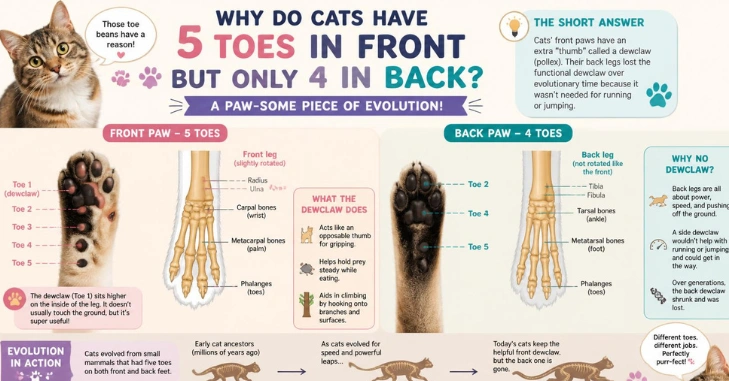
A cat’s front and hind limbs perform somewhat different jobs, and their normal toe arrangement reflects their anatomy. If you have wondered how many toes a cat have, the typical answer is 18 in total. The front paw includes four main weight-bearing toes plus a dewclaw positioned higher on the inside of the limb, while the hind paws normally have four toes each. This difference in toe arrangement is why counting all four feet gives the standard total of 18 toes.
The front paws are remarkably versatile tools for a cat. Cats use them while climbing, catching and holding objects, scratching, grooming, playing, and interacting with their surroundings, while the paw pads also contain sensitive receptors that help with balance and sensory information. Their claws curve in a way that gives cats excellent gripping and climbing ability.
What Is a Cat’s Dewclaw?
The dewclaw is the fifth digit found on the inner side of a typical cat’s front leg. It is positioned above the four primary toes, so it may not leave a mark when your cat walks across a dusty floor or produces a row of pawprints. Because of its location, owners can also accidentally overlook the dewclaw while checking or trimming their cat’s nails.
A dewclaw still has a claw even though it usually does not contact the ground in the same way as the other front claws. That means normal walking and scratching may not wear it down as effectively as other nails. Checking the dewclaws during routine paw care can therefore help owners notice excessive length, snagging, or other problems before they become uncomfortable.
Do All Cats Have 18 Toes?
No, not every cat has exactly 18 toes. Some cats are born with additional digits because of a genetic trait known as polydactyly, and these cats are commonly called polydactyl cats, mitten cats, or sometimes Hemingway cats. A polydactyl cat may have only one extra toe or several additional digits.
Extra toes most commonly appear on the front feet, although they can occur on the hind feet as well. The paws do not necessarily develop symmetrically, so one paw may have a different number of toes from another. PetMD notes that the additional digits can develop in several positions on the paw, with extra toes on the inner or “thumb” side being particularly common.
What Is a Polydactyl Cat?
A polydactyl cat is simply a cat born with more than the usual number of digits. The word “polydactyl” comes from roots meaning “many digits,” and the condition is inherited genetically rather than developing because of an injury or something the cat does after birth. Only one parent needs to carry the relevant dominant trait for polydactyly to appear in some offspring.
Polydactyly can occur in cats of different breeds and backgrounds, although it has a particularly well-known association with Maine Coons and cats in parts of eastern North America. It is also closely associated with the cats living at Ernest Hemingway’s former home in Key West, Florida, which helped popularize the nickname “Hemingway cats.” Having extra toes, however, does not make a cat a separate breed by itself.
How Many Toes Does a Cat Have?
There is no rule saying that a polydactyl cat must have only one additional toe. Some have just 19 or 20 toes, while more unusual cats can have several extra digits spread across multiple paws. The precise number and arrangement can vary because expression of the polydactyly trait is not identical in every cat.
As of September 2026, the Guinness World Record for the most toes on a cat is 29. The record belongs to Erebus, a cat from Kaukauna, Wisconsin, whose 29 toes were officially measured on May 13, 2026. Erebus surpassed the previous record of 28 toes, which had stood since 2002.
That recent record is worth noting because many older articles still state that 28 is the highest documented total. Cat anatomy itself has not changed, but record-based information can become outdated when another extraordinary polydactyl cat is verified. For an ordinary household cat, however, 18 remains the number you are most likely to count.
Are Extra Toes Bad for Cats?
Polydactyly itself is usually harmless, and many cats with additional toes run, climb, play, and live normally. VCA Animal Hospitals notes that being born with extra toes is generally not harmful, while veterinary guidance from PetMD similarly explains that most polydactyl cats do not experience mobility problems simply because they have additional digits. The important issue for owners is usually paw and nail maintenance rather than the number of toes itself.
Extra digits can create additional spaces where litter or debris collects, and some extra claws may sit at unusual angles or receive little natural wear. Those nails can become overgrown, snagged, or uncomfortable if they are not noticed during routine checks. Owners of polydactyl cats should therefore become familiar with the exact number and location of their cat’s toes and claws.
Do Cats Have the Same Number of Claws as Toes?
A typical 18-toed cat normally has 18 claws: five on each front limb and four on each hind limb. Each normal digit ends in a claw, giving cats the gripping tools they use for climbing, scratching, holding objects, defending themselves, and other natural behaviors. Purina’s cat anatomy guidance confirms the typical total of 10 front claws and eight hind claws. You might also like Cat Vomit Color Chart.
Polydactyl paws can be less straightforward because their anatomy may be unusual. Extra digits often have their own claws, which means owners can have more nails to inspect and trim than they would with an 18-toed cat. For practical care, it is better to inspect every digit individually rather than assuming a particular claw count from the appearance of the paw.
How to Check Your Cat’s Toes and Paws
Choose a time when your cat is comfortable and relaxed before attempting a paw check. Hold one paw gently and look at the toes, pads, skin between the digits, and visible claws without forcing the leg into an uncomfortable position. Repeat the process gradually rather than turning it into a struggle if your cat dislikes having its feet handled.
On the front paws, remember to locate the dewclaw higher along the inner side of each leg. Owners of polydactyl cats should pay particular attention to small or unusually positioned extra toes because their claws may be easy to miss. Regular inspection also makes it easier to recognize what is normal for your individual cat.
While checking the paws, watch for redness, swelling, bleeding, broken nails, debris, excessive nail growth, or obvious tenderness. Changes such as limping, repeatedly licking one paw, avoiding normal movement, or favoring a particular foot can also suggest discomfort. Veterinary evaluation is appropriate when a cat shows persistent pain, altered mobility, or a paw problem that you cannot safely address at home.
How Often Should You Check a Cat’s Claws?
There is no single trimming schedule that suits every cat because claw growth, activity level, age, and lifestyle vary. PetMD recommends paying attention to cat nails approximately every two to four weeks, although an individual cat may require more or less frequent trimming. Indoor cats, older cats, cats with limited activity, and polydactyl cats may need especially careful monitoring.
Scratching posts are still important because scratching is a normal feline behavior that helps cats stretch, maintain their claws, and mark their environment. However, scratching does not guarantee that every claw will remain at a safe length, particularly the elevated dewclaws or unusually positioned claws on polydactyl feet. A routine visual and hands-on check is therefore useful even for cats that scratch frequently.
Why Cat Toes Matter More Than You Might Think
A cat’s paws do far more than provide a cute collection of “toe beans.” Paw structures help absorb impact and contain sensory receptors that contribute to balance and environmental awareness. They also support the climbing and gripping behaviors for which cats are famous. Cats even have sweat glands associated with their paws, which is why nervous or warm cats can sometimes leave damp pawprints.
Knowing what a normal paw looks like makes it easier to notice changes. Once you know that most cats should have five toes in front and four behind, an additional digit, damaged claw, swelling, or unusual paw position becomes easier to spot. That basic knowledge can turn a fun anatomy fact into a useful part of everyday pet care.
The Bottom Line
So, how many toes does a cat have? For most cats, the answer is 18: five toes on each front paw and four on each back paw. The two extra front digits compared with the hind feet are the dewclaws, while cats with more than 18 toes are known as polydactyl cats.
Whether your cat has the standard 18 toes or an impressive collection of extras, regular paw checks are a useful part of routine care. Pay attention to every claw, including dewclaws and unusually positioned extra digits, and contact your veterinarian if you notice pain, swelling, limping, or nail problems. For more animal-related reading, explore the Webivest Pets section.
Frequently Asked Questions
How many toes does a cat have on each paw?
A normal cat has five toes on each front paw and four toes on each back paw. That means the two front feet have 10 toes in total, while the two hind feet have 8. Added together, a typical cat has 18 toes.
Why does my cat have 20 toes?
A cat with 20 toes is most likely polydactyl, meaning it was born with extra digits because of an inherited genetic trait. Polydactyl cats can have different numbers and arrangements of additional toes, so 20 toes is entirely possible. Most extra-toed cats are healthy, although their additional claws may need closer monitoring.
Is it normal for a cat to have six toes on a paw?
Six toes on one paw is not the standard feline arrangement, but it can occur naturally in a polydactyl cat. Extra toes appear most often on the front paws and may create the distinctive “mitten” or thumb-like appearance associated with polydactyl cats. If the extra digit is not causing pain, mobility problems, or nail complications, it is generally not considered harmful.
Do kittens have the same number of toes as adult cats?
Yes, kittens are born with their normal number and arrangement of digits rather than developing additional toes as they grow. A kitten that is polydactyl is born with the extra digits because the trait is genetic. The paws grow larger with growth, but a standard kitten is still expected to follow the five-front-and-four-back-toe pattern.
Do cats have thumbs?
Cats do not have opposable thumbs like humans. The front dewclaw is sometimes casually compared with a thumb because of its higher position on the inside of the limb, and extra digits on polydactyl cats can make the resemblance even stronger. These digits do not function exactly like a human hand, even when a cat’s paw looks remarkably mitten-like.
What cat has the most toes in the world?
The current Guinness World Records holder is Erebus, a cat in Wisconsin with 29 toes. Guinness states that the record was measured on May 13, 2026, breaking the longstanding previous mark of 28. Because this is a recent record change, articles naming a 28-toed cat as the sole record holder are now outdated.