

A petitioner is a person or organization that asks a court or another legal authority to take a specific action through a formal petition. The term identifies the party making the request. It does not mean that the person is right, has stronger evidence, or is likely to win. We cover this in more depth in Preamble.
Cornell Law School’s Legal Information Institute describes the filing party as the one who presents a petition to a court. On appeal, that person may even have been the plaintiff or defendant in the lower court.
| Key point | What it means |
|---|---|
| Main document | A petition requesting a specific legal action |
| Opposing party | Usually called the respondent |
| Common proceedings | Family law, probate, guardianship, immigration, administrative matters, and appeals |
| Same as a plaintiff? | Sometimes similar, but the correct label depends on the proceeding |
| Automatic legal advantage? | No. Filing first does not decide the merits of the case |
| Rules | Procedures and terminology can differ by court and jurisdiction |
In simple terms, the filing party asks the court to do something, while the respondent has the opportunity to answer that request. The label describes each side’s procedural position. It does not determine fault, credibility, legal rights, or the eventual outcome of the case.
What Does Petitioner Mean in Court?
A court case can begin with different types of documents. A standard civil lawsuit may begin with a complaint. Other legal proceedings begin with a petition.
The person or organization submitting that petition becomes the filing party. A Florida court glossary, for example, defines the term as the person who files an action in a court of original jurisdiction. It also applies the label to a person appealing a lower court judgment.
The petition usually explains the relief being requested. That relief could involve ending a marriage, appointing a guardian, reviewing a government decision, or asking a higher court to review a ruling.
Estate disputes provide a useful example. Someone may ask a probate court to interpret a document, appoint a representative, or resolve a dispute involving an estate. That is often where the question of whether a will can be changed after death arises.
The exact procedure depends on the court. Anyone dealing with a real case should check the rules that apply in that jurisdiction.
Petitioner vs. Respondent, Plaintiff, and Appellant
Court terminology can be confusing because several labels describe parties who bring or answer legal claims. The difference often comes down to the type and stage of the proceeding.
| Term | Basic role | Common setting |
| Filing party | Submits a petition asking for relief | Family, probate, guardianship, immigration, some appeals |
| Respondent | Answers or opposes a petition | Proceedings started by petition |
| Plaintiff | Starts a lawsuit by filing a complaint | Many civil lawsuits |
| Defendant | Party against whom a civil claim is brought | Civil litigation |
| Appellant | Asks an appellate court to reverse or modify a decision | Appeals |
| Appellee | Responds to an appeal | Appeals |
The labels are procedural rather than judgments about who is right. A plaintiff and a filing party may perform similar functions because both initiate proceedings. Courts still use different terminology depending on their rules and the document that begins the case.
The same distinction applies to the opposing side. A respondent often fills a role similar to that of a defendant, but the terms should not be treated as universal substitutes.
How the Filing Role Changes With the Type of Case
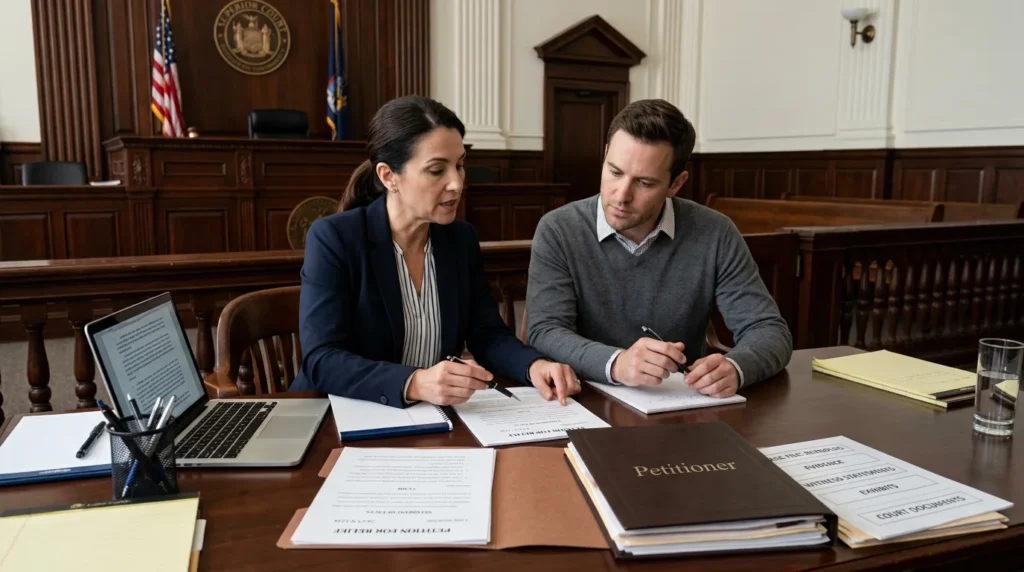
The meaning becomes clearer when you look at specific proceedings. The same basic idea applies, but the relationship between the parties can change.
Divorce and Family Proceedings
Many family courts use petition-and-response terminology. One spouse may file a petition seeking to dissolve the marriage. The other spouse is then identified as the respondent. Those labels do not establish blame. They mainly tell the court who initiated the proceeding and who must respond.
The same structure may appear in custody, guardianship, and other family-related proceedings. Local rules determine the correct paperwork and deadlines.
Appeals and Higher-Court Review
An appeal can change the labels that appeared in the original lawsuit. Cornell notes that the party asking for higher-court review may have been either the plaintiff or the defendant in the lower court. That is why a person described as a defendant in one court might later become the party requesting review.
Current U.S. Supreme Court dockets show this structure in practice. Cases seeking review identify the person requesting certiorari on one side and the responding party on the other.
Immigration Petitions
Immigration law uses the terminology somewhat differently. For family-based U.S. immigration, USCIS guidance on Form I-130 states that eligible U.S. citizens, nationals, and lawful permanent residents may file for qualifying relatives. USCIS refers to the sponsoring person as the filing party and the relative seeking classification as the beneficiary.
That distinction matters because the person submitting immigration paperwork is not necessarily the person receiving the immigration benefit. Family- and employment-based immigration processes are covered in more depth in this guide to working with an immigration lawyer.
Probate and Guardianship Matters
Probate and guardianship courts also commonly initiate certain proceedings by petition. The filing party may ask for the appointment of a guardian, the administration of an estate, or another court order.
The respondent may be the person directly affected by the requested action. In other proceedings, several interested parties may receive notice instead. Because these procedures differ among jurisdictions, the caption on the court paperwork is often the safest starting point.
Does Filing First Give You an Advantage?
Starting a case can create practical differences, but it does not automatically give the filing side the right to win. The party seeking relief normally must present the legal and factual basis for the request. The other side can respond, challenge evidence, raise defenses, and make its own requests when court rules allow.
Filing first can affect timing. The initiating party may choose when to start the proceeding and frame the first request placed before the court. That procedural head start is different from a legal advantage on the merits. Judges still decide cases under the applicable law and based on the evidence presented.
What Should You Do When You See This Term on Court Papers?
If legal papers identify you or someone else by a procedural label, focus on what the document requires rather than on the title alone.
- Read the case caption. Check the court, party names, case number, and how each side is identified.
- Identify the petition. Find the specific order, benefit, review, or remedy being requested.
- Check the response deadline. Court deadlines can affect your ability to respond or object.
- Confirm the jurisdiction’s rules. Terminology and filing procedures differ among courts.
- Get qualified legal advice when needed. A lawyer or legal-aid service can explain how the rules apply to your circumstances.
Some petitions and supporting documents may also require signatures, acknowledgments, or other formalities. Requirements depend on the document and jurisdiction. Webivest’s notary-services explainer provides related background on document verification.
The Key Point to Remember
Court labels tell you what role a party has at a particular stage of a proceeding. They do not tell you who is right.
If you find the term in legal paperwork, identify the petition, the requested relief, the opposing party, and any deadline. Then check the rules for the court handling the case. For a matter that affects your rights, property, immigration status, or family, consider getting advice from a qualified lawyer in the relevant jurisdiction.
Frequently Asked Questions
It generally means that a person or organization asks a court or other legal authority to take action through a petition. Outside the legal setting, the word can also describe someone who organizes or signs a petition.
Not always. Both may start legal proceedings, but a plaintiff usually begins a civil lawsuit by filing a complaint. Petition terminology is common in proceedings that begin with a petition.
The respondent is generally the party against whom the petition is directed or the party expected to answer it. Cornell describes the respondent as the party against whom a petition is filed, especially in appellate matters.
Yes. A person who was the defendant in a lower court can seek higher-court review after an unfavorable decision. Procedural labels can change as a case moves between courts.
No. Starting the proceeding identifies who requested court action. The result still depends on the applicable law, the evidence, procedural compliance, and the issues presented.